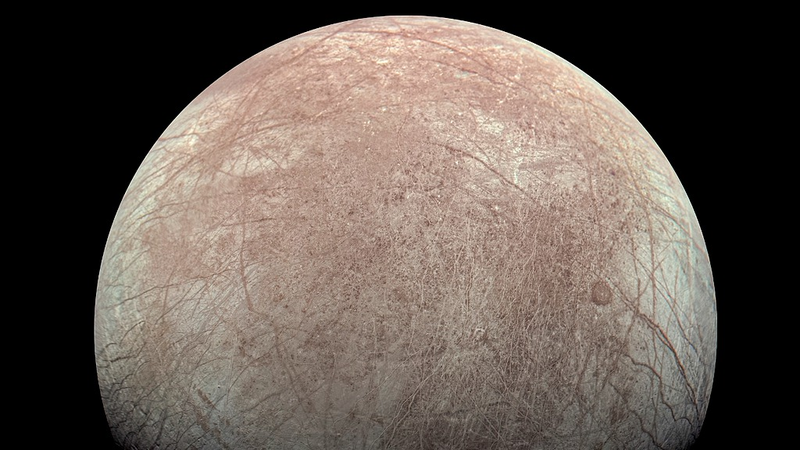
For years, Europa has been a top contender in the hunt for alien life 👽. With a vast ocean hidden beneath its icy shell, this Jupiter moon seemed like the perfect place to look for extraterrestrial microbes.
On Tuesday, a new study in the journal Nature Communications challenged that hope. Led by planetary scientist Paul Byrne of Washington University in St. Louis, the research modeled Europa’s seafloor to see if tectonic or volcanic activity could spark the chemical reactions needed for life.
The team crunched numbers on Europa’s size, rocky core composition, and the powerful tug of Jupiter’s gravity. Their conclusion? The moon’s seafloor is likely too rigid to crack and shift, making faulting and volcanism nearly impossible.
Why does this matter? On Earth, tectonic activity exposes fresh rock to seawater, fueling reactions that generate nutrients and energy—like methane—that microbial life relies on 🦠🔋. Without these processes, Europa’s ocean might lack the chemical ingredients to support life.
Europa measures about 3,100 km across, roughly a quarter of Earth’s diameter. Its ice shell is thought to be 15–25 km thick, sitting atop an ocean possibly 60–150 km deep. The moon’s ocean does contain water (twice as much as Earth’s oceans!), organic chemicals on its icy surface, and energy from tidal heating—but no seafloor fireworks to mix it all up.
While this news dims hopes for alien life on Europa, the cosmic quest for new worlds continues ✨🚀. Space is full of surprises, and scientists aren’t giving up on the search for life beyond Earth.
Reference(s):
Jupiter's moon Europa may lack key ingredients for life after all
cgtn.com