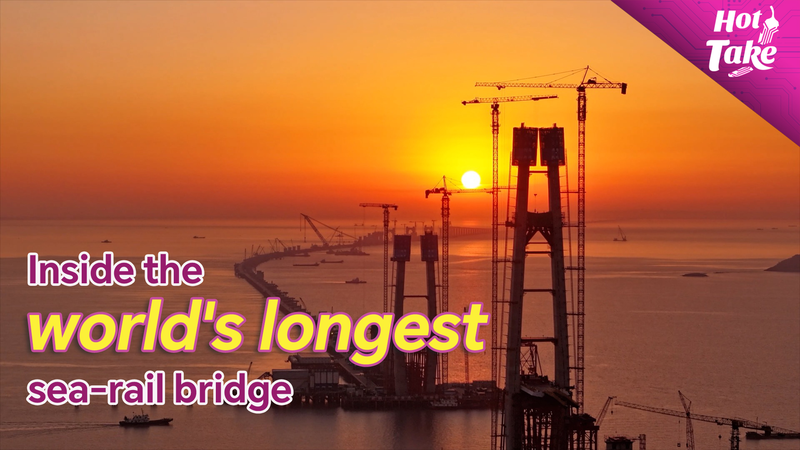
🚄 Ever wondered how engineers tame the sea to build record-breaking structures? The Hangzhou Bay cross-sea high-speed rail bridge, looming nearly 30 km across one of the Chinese mainland’s most turbulent tidal zones, is set to become the world’s longest of its kind.
Stretching across the mouth of Hangzhou Bay, this mega project will connect two major hubs in the Yangtze River Delta, slashing travel times and boosting regional growth. But before the first train races across, construction crews are battling massive waves, powerful currents, and shifting seabed sediments every day.
To tackle these challenges, engineers have designed super-strong pylons driven deep into the seabed using specialized marine pile drivers. Advanced real-time sensors monitor ground movement and tidal forces, while corrosion-resistant materials ensure the structure weathers salty air and endless waves.
CGTN reporter Chen Yilin visited the site and discovered how teams coordinate like clockwork: divers mapping underwater conditions, drone fleets surveying pylon heights, and offshore platforms acting as mobile workshops. It’s a high-stakes puzzle where precision and creativity rule the day.
Once complete, this rail bridge will be more than an engineering marvel—it’s a symbol of innovation pushing the limits. For travelers, businesses, and students in the region, it promises faster commutes, new economic opportunities, and a front-row seat to human ingenuity in action.
Stay tuned as this tidal titan takes shape on the waters of Hangzhou Bay! 🌊🛠️
Reference(s):
Hot Take: Inside the world's longest cross-sea high-speed railway
cgtn.com