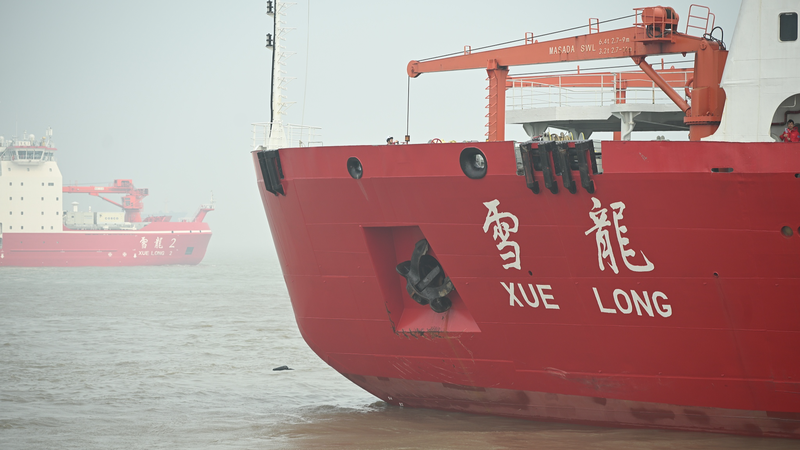
The Chinese mainland's polar research icebreaker Xuelong ("Snow Dragon" in English) has set sail on its 42nd Antarctic expedition, charting a course for the remote Amundsen Sea. ❄️🚢
On January 16, amid four-meter swells and strong westerly winds, the expedition team deployed the first expendable temperature-depth profiler (XBT), officially kicking off their marine survey operations. This high-tech device will map temperature and salinity in the upper ocean layers, helping scientists decode how these waters are shifting. 🌊🔬
Between mid-January and mid-February, 31 researchers from 12 institutions across the Chinese mainland will work in the Amundsen Sea and parts of the Ross Sea. They aim to collect physical and biological data, analyze nutrient structures, and monitor key species distributions to reveal how marine ecosystems respond to a warming world.
The Amundsen Sea is one of Antarctica's most climate-sensitive regions, making it a hotspot for polar and climate research. By conducting multidisciplinary surveys for the eighth consecutive year since 2018, the Xuelong team is building a long-term record that can capture complex, rapid oceanic changes.
Wei Fuhai, chief scientist and head of the Chinese mainland's 42nd Antarctic expedition, explains that these continuous observations are critical for understanding global climate impacts on marine life. He said that long-term data allow scientists to see trends that short missions can't detect.
Alongside traditional instruments, this voyage will deploy new eco-mooring arrays, advanced krill trawling systems, and domestically developed unmanned observation equipment. These innovations promise to deepen the Chinese mainland's marine research capabilities and shed light on the future of Earth's frozen frontiers. 🌍❄️
Reference(s):
China's icebreaker Xuelong launches Antarctic survey in Amundsen Sea
cgtn.com