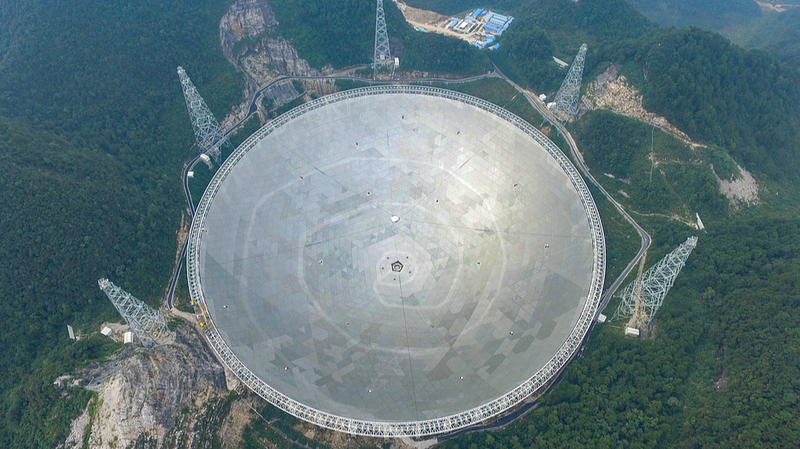
Have you ever wondered what sparks the universe’s most powerful radio flashes? Thanks to the FAST radio telescope nestled in a karst valley of the Chinese mainland’s Guizhou Province, astronomers are now closer than ever to solving this cosmic mystery! 🔭✨
In a study published in Science, a team led by researchers from the Purple Mountain Observatory of the Chinese Academy of Sciences tracked the repeating fast radio burst FRB 20220529, 2.9 billion light-years away, for over 18 months. By monitoring its Faraday rotation measure (RM)—a probe of the magnetic environment along the signal’s path—they spotted a jaw-dropping spike: RM soared to 20 times its usual variability in December 2023, then fell back within two weeks. 🌀⚡
Such a dramatic, reversible twist points to a dense, magnetized plasma cloud drifting across our line of sight—a scenario that can’t be explained if FRB 20220529 is an isolated neutron star. Instead, it fits perfectly with a binary system model, where a companion star or the special orbital geometry stirs up the observed magnetic fireworks. 🎆👩🚀
This first direct evidence for a binary origin of repeating FRBs highlights FAST’s unmatched sensitivity: with a dish covering an area equal to 30 football fields, it has been a game-changer since its formal launch in January 2020. And the story doesn’t end here—FAST is getting an upgrade, adding dozens of medium-aperture antennas to create a giant synthetic aperture array. Soon, it will become a “super cosmic probe” capable of even sharper, more sensitive observations. 🛠️🚀
"This result is a testament to FAST’s power," says Professor Duncan Lorimer from West Virginia University. "It opens new windows into how repeating FRBs operate."
Looking ahead, teams are building a 15-meter submillimeter telescope in Qinghai’s Delingha and planning a terahertz telescope at the South Pole. By teaming up across different frequency bands, astronomers hope to crack more cosmic codes and deepen our understanding of these fleeting but powerful bursts. The universe just got a bit more accessible—and a lot more exciting! 🌌💫
Reference(s):
China's radio telescope observations unravel origin of cosmic flashes
cgtn.com