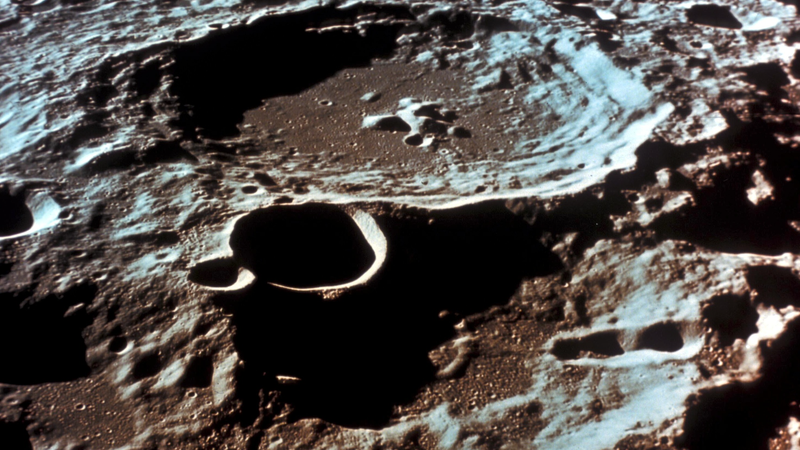
Have you ever wondered why the moon’s near side has more volcanic seas than its far side? A new study published this year in the Proceedings of the National Academy of Sciences sheds light on this cosmic mystery. 💫
A group of Chinese researchers, led by Tian Hengci at the Institute of Geology and Geophysics, Chinese Academy of Sciences, analyzed the potassium (K) isotopes in basalt samples returned by the Chang'e-6 mission from the South Pole–Aitken Basin, the largest and oldest impact crater on the moon’s far side.
They found these basalts carry significantly heavier K isotopic signatures compared to Apollo lunar samples and meteorites. After ruling out factors like cosmic-ray exposure, volcanic differentiation, and asteroid contamination, the team concluded that the intense heat and pressure from the giant collision drove off lighter K isotopes, leaving behind a residue enriched in heavier isotopes. 🔥➡️❄️
Why does this matter? The loss of volatile elements like potassium can suppress magma formation. This means the far side of the moon may have experienced fewer volcanic eruptions, helping explain its smoother appearance compared to the more “sea”-filled near side. 🌊 vs. 🌑
This discovery not only deepens our understanding of the moon’s evolution but also highlights how dramatic impacts shape planetary bodies. It’s a stellar reminder that cosmic events billions of years ago still influence what we see in the sky tonight. 🌌
What's next? Scientists hope to apply similar isotope detective work to other moons and planets, unlocking more secrets of our solar system. Stay tuned for more out-of-this-world science! 🚀
Reference(s):
Giant impact on moon's far side led to volatile loss from lunar mantle
cgtn.com