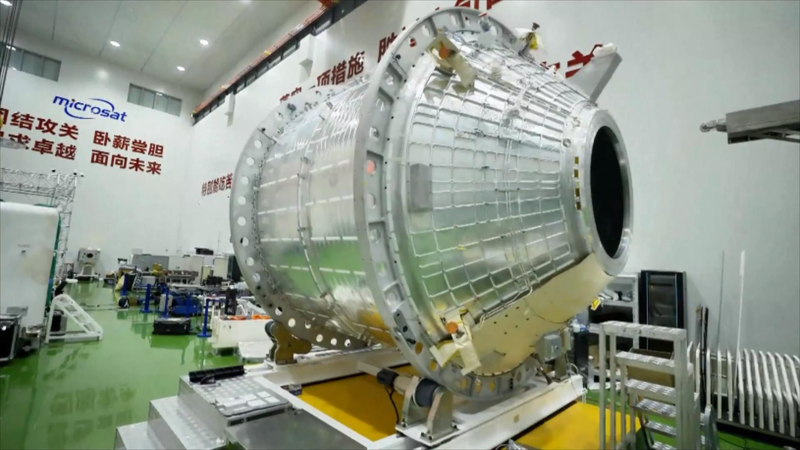
China is gearing up to build its next-generation cargo spacecraft, Qingzhou, with prototype development slated for early 2026 🚀. Developed by the Innovation Academy for Microsatellites at the Chinese Academy of Sciences, Qingzhou has already completed multiple key technology verifications and has entered integrated testing.
After passing its design review in June 2025, the prototype moved into initial manufacturing. Full engineering model production is scheduled to begin in early 2026, keeping the project on track to boost logistics for China's space station.
At 3.3 meters in diameter and weighing 5 tonnes, Qingzhou can carry 1.8 tonnes of cargo to orbit. Its unique design combines a pressurized module for taikonauts' supplies and precision instruments, with an unsealed aft section for external payloads and space-exposure experiments 🛰️.
Inside, four cargo racks provide 40 compartments across 27 cubic meters. The craft also features five 60-liter cold-chain units to keep food and biological samples at optimal temperatures ❄️.
Future versions will include an intelligent cargo management system that lets astronauts locate items via voice commands, streamlining operations and reducing workload.
Designed for two-way logistics, Qingzhou will deliver supplies to the space station and return up to 2 tonnes of waste. As of late 2025, demand for diverse, cost-effective cargo solutions is rising, making Qingzhou a flexible, intelligent answer to the station's evolving needs.
Reference(s):
China to start prototype development of new cargo spacecraft in 2026
cgtn.com