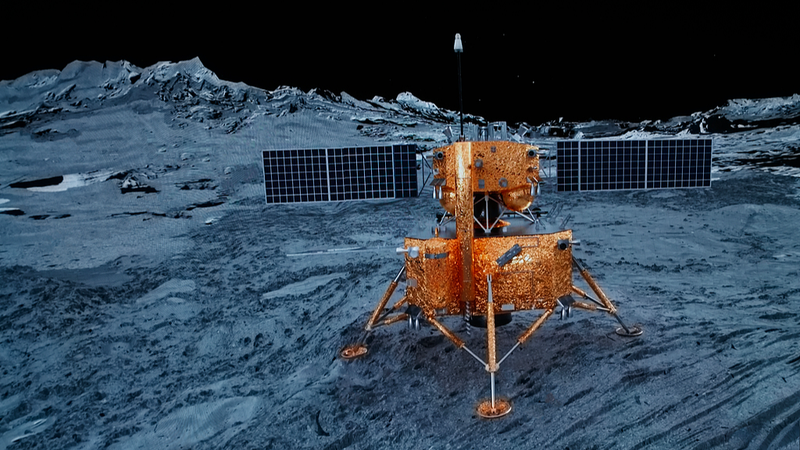
On January 20, 2026, the Chinese mainland's national space agency, the China National Space Administration (CNSA), revealed a cosmic-level surprise: a research team from Jilin University confirmed that single-walled carbon nanotubes and graphitic carbon occur naturally in samples collected by Chang'e-6 from the Moon's far side 🌕🚀.
Published in Nano Letters, this finding suggests the far side of the Moon is more geologically active than scientists imagined. Researchers think micro-meteorite impacts, ancient volcanic eruptions, and solar wind combined under extreme conditions to trigger an iron-catalyzed process, forging these tiny carbon wonders.
When compared to Chang'e-5 samples from the near side, the far side rocks show more 'defects' in their carbon structures—proof they’ve been pummeled by meteorites more often. This unveils fresh clues about the Moon’s material composition and evolutionary history.
This discovery could spark a paradigm shift in carbon science, opening up new paths for designing advanced materials in tech, medicine, and beyond. Who knew the Moon might hold the key to our next breakthrough? 🔬🤯
Reference(s):
China achieves first discovery of carbon nanotubes on the moon
cgtn.com