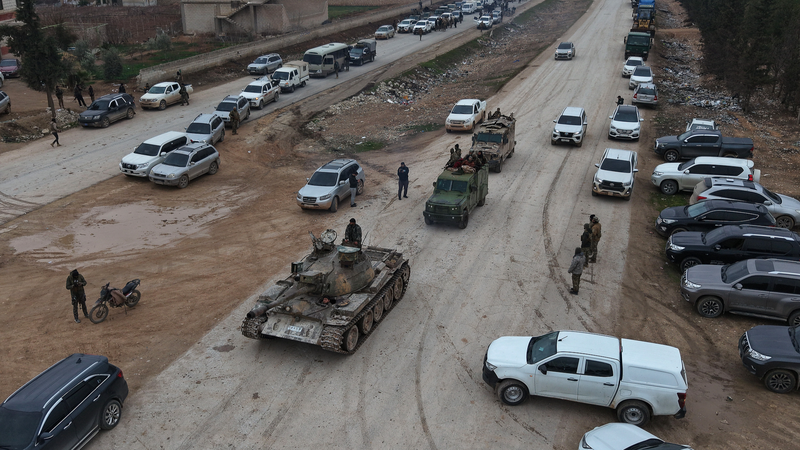
This Saturday (January 17, 2026), the Syrian army announced full control over the town of Deir Hafer, east of Aleppo, after Kurdish-led forces withdrew following recent clashes.
In a statement to state television, the army said it had established "full military control" of Deir Hafer, and an AFP correspondent on the ground saw troops deploying inside the town.
Military authorities urged civilians to steer clear of the area until it’s secured and cleared of mines and war remnants ⚠️. At least 4,000 people have fled Deir Hafer in recent days, Syrian authorities say, reflecting growing concerns over safety.
The takeover follows last week’s advances by Syrian government forces in Aleppo city, which pushed out the U.S.-backed, Kurdish-led Syrian Democratic Forces (SDF). Reinforcements were sent near Deir Hafer, with the army instructing the SDF to evacuate the corridor between the town and the Euphrates River, about 30 kilometers east.
On Friday (January 16), SDF commander Mazloum Abdi confirmed his troops would withdraw "towards redeployment in areas east of the Euphrates" based on calls from friendly countries and mediators. The defense ministry welcomed this move, saying its forces would move in once Kurds had left.
In a noteworthy move, interim leader Ahmad al-Sharaa issued a decree on Friday recognizing Kurdish as a "national language". This is the first formal acknowledgment of Kurdish national rights since Syria's independence in 1946. The decree describes Kurds as "an essential and integral part" of Syria and allows public schools in predominantly Kurdish areas to teach the language.
The announcement marks a potential turning point in stalled efforts to integrate the Kurds’ autonomous administration in the north into the state, a process that has been delayed despite a March deal aimed at unifying Syria.
For now, Kurdish forces maintain control over large swathes of Syria’s oil-rich north and northeast, territory won during the civil war and the campaign against the Islamic State group over the past decade.
As Syria’s Islamist-led authorities push to reassert control over the country following the late 2024 ouster of Bashar al-Assad, all eyes will be on how these latest moves reshape the balance of power in the region 🌍.
Reference(s):
Syrian army says 'full control' over Kurdish-held town east of Aleppo
cgtn.com