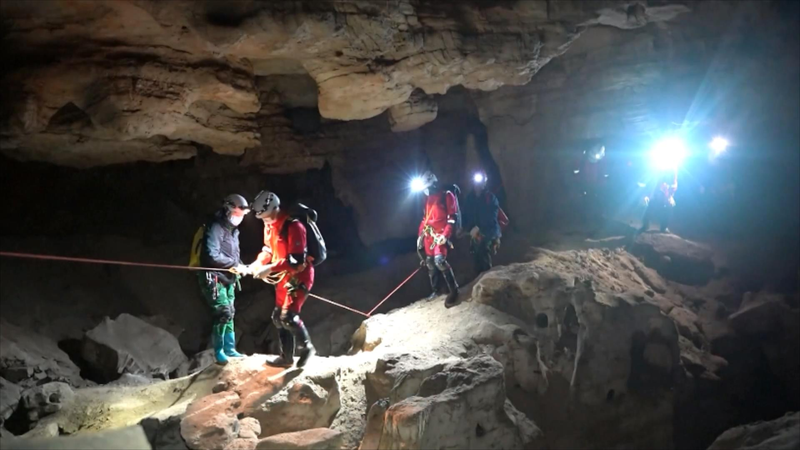
Recently, 28 astronauts from the Chinese mainland embarked on a cave-training mission deep in the mountains of Wulong District, Chongqing Municipality. Over six days and five nights, they braved average temperatures of 8°C and 99% humidity to simulate the rigors of space. 🌑🥶
Divided into four teams, they practiced environmental monitoring, cave mapping, simulated space-to-ground communications and team-focused psychological tests. They squeezed through ultra-narrow passages 🕳️, rappelled sheer walls and endured prolonged cold, dampness and sensory deprivation.
Song Lingdong, veteran of the Shenzhou-19 mission, says the cave’s harshness forged stronger bonds. "The darkness and chill pushed us to rely on each other. We became more passionate and determined to complete every task," he explains. 🤝
Zhu Yangzhu of the Shenzhou-16 crew compares the deep silence to space itself. "Turning off all lights made it pitch-dark—you couldn’t see your fingers. You feel your heartbeat and breath. It’s the closest thing to true space quietness," he says.
Tang Hongbo, commander of Shenzhou-17, led one of the teams underground. "Staying responsible for everyone’s safety in total darkness was intense. Every step felt like a mission-critical decision," he recalls.
Liu Yang, the first woman from the Chinese mainland in space, likens the final exit to a safe spacecraft landing. "Walking out of the cave was pure relief and excitement—like reporting our success back to mission control," she says. 🚀
Since 2016, the China Astronaut Research and Training Center (CARTC) has scouted more than 10 caves across seven provincial-level regions—including Guangxi, Guizhou, Hunan, Anhui and Chongqing—to find venues that replicate space extremes. The Wulong cave was chosen for its geological stability, challenge level and life-safety conditions.
CARTC plans to run this cave-training mission again for new recruits and anyone who missed it. It’s the next frontier on Earth for preparing astronauts to explore the final frontier in space.
Reference(s):
Chinese astronauts detail cave training for extreme environments
cgtn.com