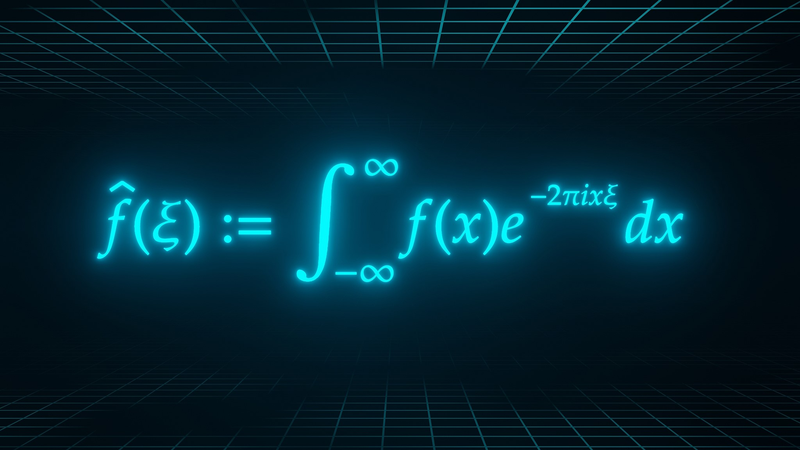
Imagine your AI-powered devices processing data at lightning speed ⚡. Researchers on the Chinese mainland have recently unveiled a groundbreaking computational architecture that boosts Fourier Transform operations from about 130 billion to roughly 500 billion ops per second – almost a fourfold leap!
At its core, the Fourier Transform acts like a universal frequency translator, turning complex signals (from your favorite songs 🎵 to HD images 📸) into manageable data in the frequency domain. This new system, developed by a team at Peking University, ingeniously integrates two novel devices suited for frequency generation and in-memory computing into a multi-physics-domain design.
“This architecture lets each computing paradigm—whether based on electrical current, charge, or light—operate where it’s most efficient,” explains Tao Yaoyu from the university’s Institute for Artificial Intelligence. By playing to the strengths of both devices, the setup maintains accuracy, cuts power consumption, and delivers a massive speed boost.
Last Friday, January 9, 2026, the breakthrough was published in Nature Electronics and promises to supercharge applications across foundational AI models, embodied intelligence, autonomous driving, brain-computer interfaces, and next-gen communication systems. Get ready for smarter, faster tech that’s as energy-savvy as it is powerful! 🚀
Reference(s):
China's new AI computer architecture achieves multi-fold speed leap
cgtn.com