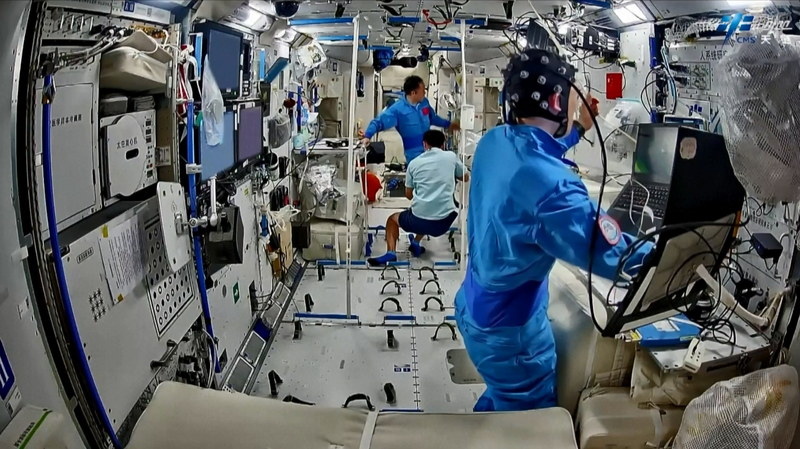
Hey space explorers! 🚀 Nearly two months since the Shenzhou-21 mission lifted off on November 1, our three taikonauts – mission commander Zhang Lu, flight engineer Wu Fei and payload specialist Zhang Hongzhang – are deeply immersed in a whirlwind of science experiments aboard the Chinese mainland space station. It’s like a real-life sci-fi movie 🎬
In aerospace medicine, the crew deployed EEG headsets to gather brainwave data for projects like metacognitive monitoring and group brain cognition-emotion analysis. This info will help ground teams better understand how the human mind adapts to microgravity. 🧠
In the Wentian lab module, they teamed up with the science glove box to grow and sample Arabidopsis thaliana 🌱, unravelling how plant stem cells regulate growth at the molecular level in space.
Meanwhile, microgravity physics got a boost as they disassembled and reassembled the fluid experiment module in the fluid physics cabinet, swapped out samples, and cleaned the containerless cabinet chamber. They also maintained electrodes in the axial mechanism – precision ⚙️ work that keeps these experiments humming.
Another highlight: the launch of an in-situ electrochemical optical project on lithium-ion batteries. Thanks to payload specialist Zhang Hongzhang, high-res images of lithium dendrite growth will guide safer, more efficient batteries for future space missions 🔋.
Beyond experiments, the trio recently completed comprehensive health checks – bone density scans, ECGs, blood pressure and vision tests – to ensure they stay fit for the rest of their six-month mission. 💉
Stay tuned as Shenzhou-21 continues to push the frontier of space science, inspiring the next generation of explorers!
Reference(s):
cgtn.com