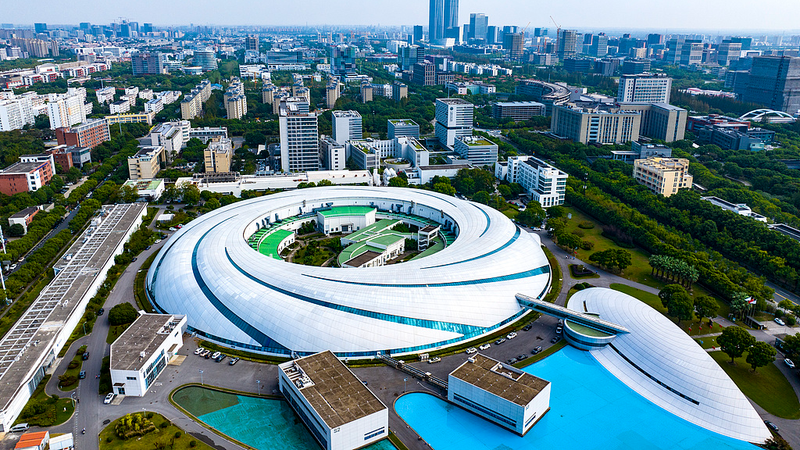
In the heart of Zhangjiang, Shanghai, a gleaming silver donut known as the Shanghai Synchrotron Radiation Facility (SSRF) has been shining bright since its completion in 2009 💡. Nicknamed the Shanghai Light Source, it’s powered over 20,000 experiments and become a symbol of the region’s cutting-edge spirit.
Last year, nearly half of the SSRF’s users came from the Yangtze River Delta (YRD) region—Shanghai plus Jiangsu, Zhejiang, and Anhui provinces. What started as a local beamline project has grown into a masterclass in how regional integration can fuel national high-quality development.
Shanghai’s labs and universities are on fire 🔥. In the first half of 2024, one in three research papers from the Chinese mainland published in top international journals had Shanghai names on them. At the same time, an average of 320 new tech startups sprang up every single day, backed by over 800,000 specialists in fields like integrated circuits, biomedicine, and AI.
Beyond Shanghai’s borders lies the G60 Science and Technology Innovation Corridor—a 600 km hyper-cluster connecting the YRD’s core cities. It now hosts one-seventh of the Chinese mainland’s high-tech firms and 20% of companies on the STAR Market, the mainland’s Nasdaq-style tech board 🚀.
Take aerospace: in Shanghai’s Lingang Special Area, the Big Plane Park sits at the center of a network where one-third of all aircraft component suppliers are within a three-hour high-speed rail trip. This tight-knit setup slashes costs and fast-tracks prototypes into production.
In September 2025, regional authorities launched the Decision on Promoting Coordinated Development of Science and Technology Innovation in the YRD. And at the Central Economic Work Conference in early December 2025, leaders named the Shanghai (Yangtze River Delta) International Science and Technology Innovation Center a priority for 2026, alongside hubs in the Beijing-Tianjin-Hebei region and the Guangdong-Hong Kong-Macao Greater Bay Area.
The world is taking notice. According to the World Intellectual Property Organization’s 2025 Global Innovation Index, the YRD’s clusters rank among the globe’s best: Shanghai-Suzhou is 6th, Hangzhou 13th, Nanjing 15th, and Hefei 39th. By sharing 56,000 pieces of scientific equipment across provinces and linking 200 global universities with 600 top companies, the YRD shows that tearing down administrative barriers can unleash collective high-tech power.
The Yangtze River Delta is lighting the path to a new era of innovation in the Chinese mainland. Stay tuned as this hyper-cluster continues to shape tomorrow’s technology! 🔬🌟
Reference(s):
How China's Yangtze River Delta drives national high-tech innovation
cgtn.com