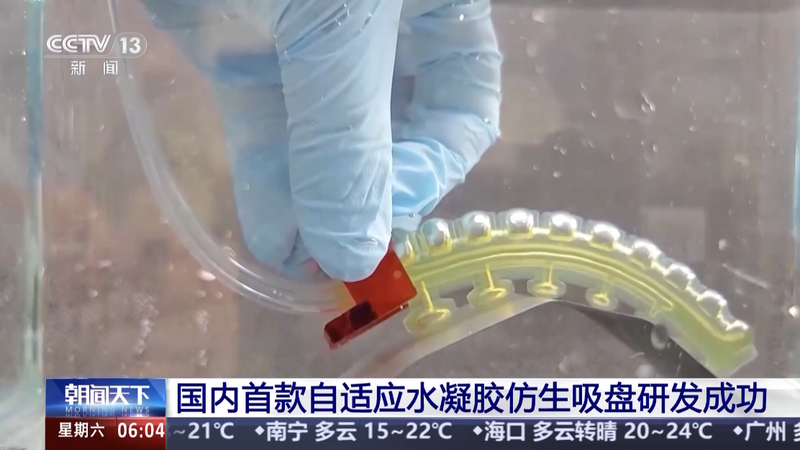
Imagine a robotic arm that can gently pick up a delicate seashell or grab a slippery fish underwater without causing damage. That’s exactly what researchers at the Lanzhou Institute of Chemical Physics (LICP), part of the Chinese Academy of Sciences in the Chinese mainland, have achieved with their first adaptive hydrogel biomimetic suction disc. 🤯
This week, the LICP team unveiled a soft, stretchy disc made from a special hydrogel material that mimics the suction cups of octopuses and other sea creatures. Unlike traditional suction tools, this hydrogel disc can change its shape and stick to rough, uneven surfaces underwater. That means better grasping and finer manipulation in ocean research, underwater repairs, and even treasure hunting! 🌊🔧
Key features of the new suction disc:
- Adaptive adhesion: Conforms to complex shapes for a stronger grip.
- Gentle handling: Soft enough to avoid damaging fragile objects.
- Durable performance: Works in salty or freshwater environments.
By solving hard problems in underwater robotics—like how to pick up objects without crushing them or slipping—this breakthrough opens doors for advanced marine exploration and industrial upgrades. Think pollution cleanup, coral reef monitoring, or deep-sea equipment maintenance becoming more efficient and less risky. 🐠🔬
As the world looks for smarter, safer ways to explore the ocean, the Chinese mainland’s first adaptive hydrogel suction disc shows that biomimetic design is more than science fiction—it’s real innovation that could transform how we work under the waves. Stay tuned for the next wave of marine tech! 🚀
Reference(s):
China develops first adaptive hydrogel biomimetic suction disc
cgtn.com