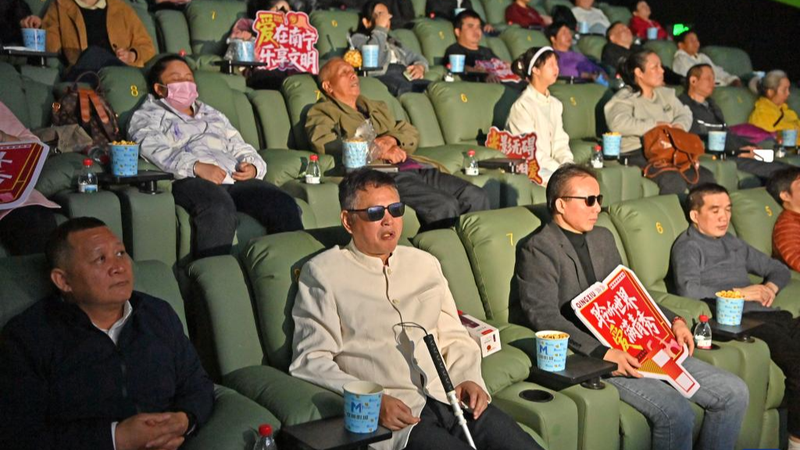
Yesterday, on December 3, International Day of Persons with Disabilities, a special screening brightened a community center in Xicheng District, Beijing. About 40 attendees, including Xu Wei, a film lover with a visual impairment, settled in to watch the Chinese street dance film "One and Only." 🎬
But this wasn't an ordinary movie night. Between lines of dialogue and sound effects, detailed audio descriptions painted the scenery, action, and even actors' body language. It was all thanks to Guangming Cinema, a volunteer-driven nonprofit whose name means "light and brightness." ❤️
Founded in December 2017 by volunteers from the Communication University of China, Guangming Cinema has grown into a powerhouse for accessible films. Over the past eight years, more than 800 faculty members and students have teamed up to create over 800 audio-described movies for people with visual impairments.
The process is intense. To adapt a 90-minute film, volunteers watch it ten times, then craft a 20,000–30,000 character narration script. Next, three students, two mentors, and a visually impaired participant spend 28 days recording and mixing the audio. Fu Haizheng, one of the project's founders, says every detail matters.
Hu Fang, a project volunteer, still remembers a child in the audience asking, "What is the color red?" That moment led the team to rework descriptions so they make sense through sound, not just sight. Now the narration is more immersive and three-dimensional. 🎧
Yesterday's Beijing event was part of a program in partnership with over 100 community cultural centers across the country. China's 17 million people with visual impairments make this work crucial. Many films are also shared on cable and online platforms, and every one of the 2,244 special education schools in the Chinese mainland receives a secure hard drive packed with accessible titles.
The impact goes beyond film. "Accessible cinema adds color to our lives and gives us a reason to go out," says Cao Jun, deputy chair of the Beijing Association of the Blind. Surveys show willingness to attend these screenings jumped from 13% to 63% in just a few years.
Looking ahead, Fu hopes to expand accessible guidance so people with all kinds of disabilities can enjoy films, exhibitions, museums, and more. After all, everyone deserves equal access to the arts. 🌟
Reference(s):
How a Chinese company makes movies accessible to the visually impaired
cgtn.com